
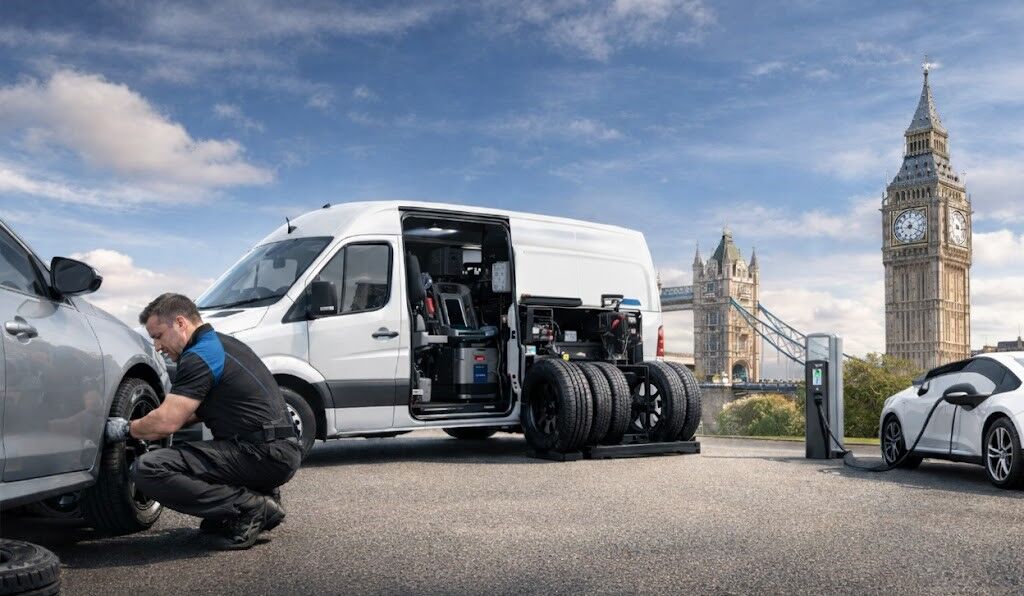

The automotive landscape in the United Kingdom has reached a fascinating turning point in 2026. If we look back just five or ten years, the idea of a professional tyre technician arriving at your driveway within 60 minutes felt like a premium luxury reserved for high-end roadside assistance.
Fast forward to today, and it has become the gold standard for every driver. The traditional “brick-and-mortar” garage model is facing a massive challenge from a more agile, customer-centric alternative: The Mobile Tyre Fitting Revolution. In this deep dive, we explore the shift in consumer psychology, the technology driving it, and why the modern UK driver now considers mobile fitting a common-sense necessity.
1. Time as the New Global Currency
In 2026, the average person’s schedule is more fragmented than ever. With the rise of hybrid work and the “gig economy,” the old-fashioned way of taking a car to a garage is logically flawed.
The Traditional Hassle:
- Identifying a tyre issue during a busy workday.
- Searching for a local garage with availability.
- Booking an appointment (often days in advance).
- Driving to the location (wasting fuel and battling traffic).
- Waiting in a cold, noisy room for 1–2 hours.
For a modern professional or a busy parent, this is a massive drain on productivity. Mobile tyre fitting solves this by flipping the script. Instead of you going to the service, the service integrates into your life. Whether you are at your desk, at the gym, or finishing breakfast, the work happens in the background. In 2026, convenience isn’t just about ease-it’s about smart time management.
2. Safety: Eliminating the “Limp Mode” Risk
One of the most critical aspects of this evolution is road safety. Historically, drivers with a slow puncture or a damaged sidewall would “limp” their vehicle to the nearest shop. In 2026, road safety regulations and vehicle technology have made this practice both legally risky and mechanically dangerous.
Modern cars are equipped with complex sensors and low-profile tyres. Driving even a short distance on a failing tyre can lead to:
- Irreparable Rim Damage: A cost that far exceeds a simple tyre replacement.
- Suspension Stress: Uneven weight distribution puts immense strain on the vehicle’s geometry.
- Insurance Liability: Many providers in 2026 have introduced stricter “contributory negligence” clauses if you drive a vehicle known to be unroadworthy.
By calling a professional to your exact location, you eliminate the risk of a dangerous blowout on the way to a garage. It is the ultimate common-sense safety move.
3. The Economic Logic: Why Mobile Wins on Price
There is a persistent myth that convenience always comes with a premium price tag. However, the economics of 2026 tell a different story.
Traditional garages have massive overheads. They pay high rents for prime real estate, business rates, heating for large workshops, and maintenance for a physical storefront. Mobile tyre services operate with a much leaner model. Their “storefront” is a high-tech van.
By cutting out the expensive physical location, mobile providers can offer competitive pricing that often beats the big-name high-street dealers. Furthermore, when you calculate the hidden costs of a traditional garage visit-fuel, lost working hours, and potential childcare or alternative costs, the mobile option is almost always the more financially attractive choice.
4. 2026 Technological Breakthroughs
The reason mobile tyre fitting is so dominant now is the technology inside the vans. In the past, mobile units were seen as “emergency patches.” Today, they are high-performance mobile workshops.
- Precision Balancing: The current generation of mobile balancers uses laser-guided technology to ensure a perfect fit, identical to what you’d find in a high-end Formula 1 pit lane.
- Digital Diagnostics: Technicians now use handheld scanners to check alignment and tread depth instantly, sending a full health report directly to the customer’s smartphone.
- On-Demand Tracking: Much like tracking a delivery, you can see exactly where your technician is. This transparency has built a new level of trust between the driver and the service provider.
5. Green Logistics and Environmental Responsibility
As the UK pushes toward its Net Zero goals, the environmental impact of our choices matters. At first glance, you might think a van driving to your house is less green than you driving to a shop. However, advanced routing algorithms change that math.
Instead of ten different customers driving ten separate cars to a central hub, one optimised van travels in a logical circuit to service them all. This reduces the total “tyre-on-road” miles, lowering the overall carbon footprint of the maintenance industry. Additionally, many mobile units in 2026 are now electric, further reducing emissions.
6. Specialised Services for the EV Era
By 2026, the number of EVs on UK roads will have skyrocketed. EVs have unique requirements:
- Weight: They are significantly heavier than petrol cars due to the batteries.
- Torque: Instant torque means tyres wear out faster.
- Acoustics: EV-specific tyres are designed for low road noise.
Mobile fitting specialists have adapted to these needs much faster than traditional “generalist” garages. They carry the specific high-load tyres required for Teslas, Polestars, and E-Transit vans, ensuring the customer gets the right product for their specific vehicle tech.
7. Reliability in a 24/7 Society
The UK doesn’t sleep in 2026. From delivery drivers to healthcare professionals, thousands of people are on the road in the middle of the night. A tyre emergency at 3 AM used to mean a stressful wait for a recovery truck and a night spent in a depot.
Now, specialised brands have filled this gap. By offering 24/7 mobile tyre fitting, they provide a lifeline to essential workers. This reliability is what has built the brand “Mobile Tyre Giant” into a household name-it’s about being there when the customer is at their most vulnerable.
8. Why “Common Sense” Always Wins
Ultimately, the dominance of this service is about human-centric design. For decades, the automotive industry expected humans to adapt to the machine’s needs. In 2026, the machine (and its maintenance) adapts to the human.
The mobile model offers:
- Transparency: No hidden “garage fees” or upsells.
- Comfort: Your own sofa vs. a plastic chair in a waiting room.
- Speed: Often same-day or next-day service.
Conclusion: Looking Ahead
As we move further into the decade, the static garage will likely become a place only for heavy mechanical repairs. For everything else-especially the mobile model, is the undisputed king. It represents a smarter, safer, and more respectful way to treat the UK motorist.
If you value your time and want the peace of mind that comes with professional, on-site expertise, there is no reason to look back. The future of car maintenance is parked right outside your front door. Ready to experience the 2026 standard? You can find the best tyres and book your slot through a professional mobile tyre fitting service today.
FAQ: Everything You Need to Know
1. Is mobile tyre fitting as reliable as a garage?
Absolutely. In 2026, mobile vans are basically “mini-workshops” equipped with the latest laser-guided balancers and industrial tyre changers. You get the same precision you would in a high-street shop, just without the waiting room.
2. Can you fit tyres on a slanted driveway or in the rain?
Yes. As long as the ground is reasonably firm and safe, technicians can work in most weather conditions. Most modern vans come with retractable awnings and specialised safety equipment to handle UK weather while your car stays in your driveway.
3. What do I need to provide for the technician?
You don’t need to provide power or tools. The only things the fitter needs are your car keys and the locking wheel nut key (usually found in the glovebox or boot). They handle the rest, from lifting the car to disposing of your old tyres.
4. Do they handle Electric Vehicles (EVs)?
Yes. Modern mobile specialists carry the specific high-load tyres required for EVs (like Teslas or ID.4s) and use specialised jacking equipment to protect the battery packs. It is often safer than using a generalist garage that might not be EV-ready.
5. How long does the process actually take?
Efficiency is the biggest benefit. On average, a single tyre change takes about 20 minutes, while a full set of four can be completed in roughly 60 to 75 minutes. Since there is no “queue,” you are back on the road much faster than at a traditional centre.